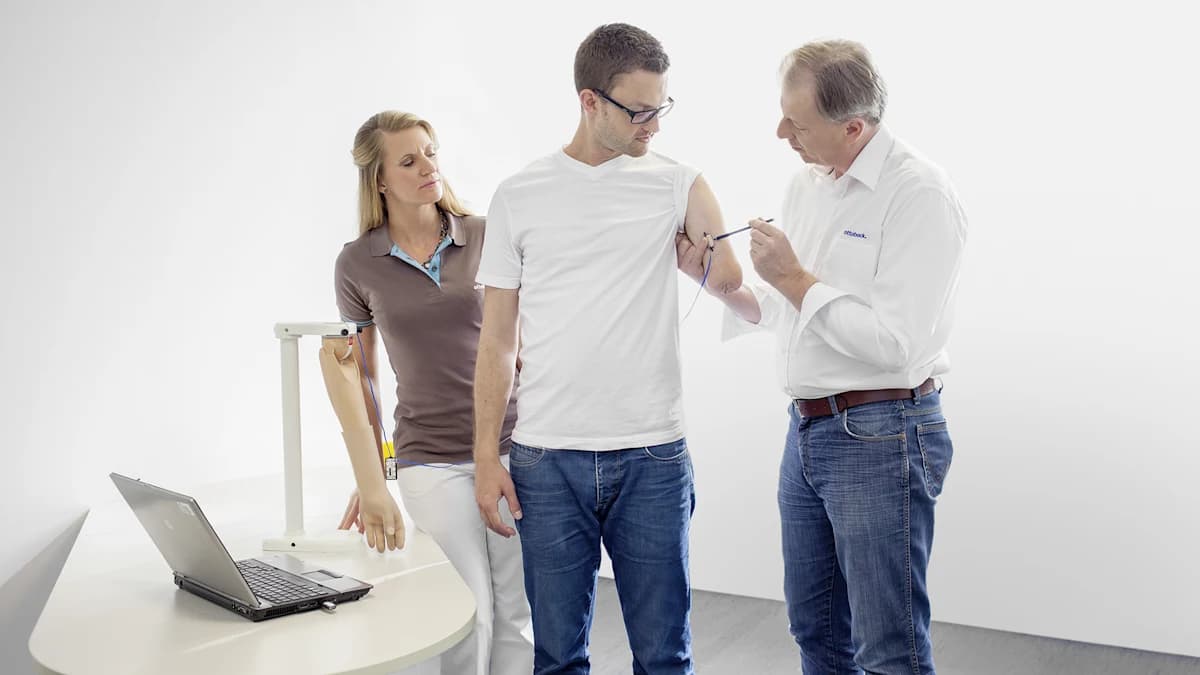
Up to six independent signals
Complex motor training during rehabilitation creates up to six independent muscle signals that significantly improve your control of your prosthesis.
Surgical Technique
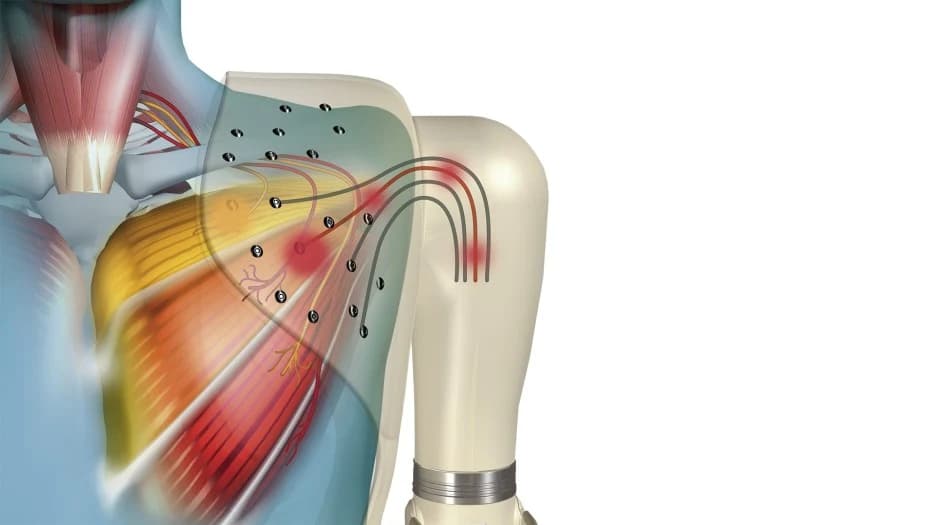
The goal of a TMR fitting is to enable arm amputees to use their prosthesis intuitively. For this purpose, nerves that transmitted signals to the natural arm are connected to other muscles.
Concept
After an upper limb amputation, your nerves are still functional up to the amputation site. These nerves can generally integrate themselves into a different muscle and trigger a contraction. The concept of TMR is based on triggering a natural repair mechanism artificially — a muscle that is no longer functional after your amputation is divided into several segments surgically.
The original nerve supply for this muscle is severed. The surgically relocated nerve ends become incorporated into the muscle. This process of establishing a targeted new connection is called targeted reinnervation.
Benefits
Complex motor training during rehabilitation creates up to six independent muscle signals that significantly improve your control of your prosthesis.
After a TMR fitting, you control your prosthesis using up to six different thoughts about natural movements — simply think of making a fist and the corresponding muscle is activated.
Several prosthetic movements can be carried out at the same time — quickly and intuitively — making everyday tasks feel more natural.
TMR is an established treatment method following amputation of the upper arm or shoulder disarticulation, with a proven track record in clinical practice.
Your rehabilitation team guides you through targeted motor training so you can selectively activate the reinnervated muscles for precise control.
Combine TMR signals with advanced bionic hands to unlock the full potential of multi-grip, intuitive prosthesis use.
Rehabilitation
During your rehabilitation process, complex motor training will ensure that you can activate the reinnervated muscles appropriately and selectively. This creates up to six independent muscle signals that significantly help to improve your control of your prosthesis.
TMR is an established treatment method following amputation of the upper arm or shoulder disarticulation. After a TMR fitting, you control your prosthesis using up to six different thoughts about natural movements. For example, simply think of making a fist or closing your hand, and the corresponding muscle will be activated, with the associated signal then closing the prosthetic hand. This way, several prosthetic movements can be carried out at the same time, quickly and intuitively.
Resources
To find out more about TMR, including where you can visit for an assessment, please get in touch with our expert team.

Check out our range of upper limb prosthetics, including the innovative bebionic and Michelangelo hand.
Talk to our expert team to learn more about TMR and where you can visit for an assessment.
Contact Us