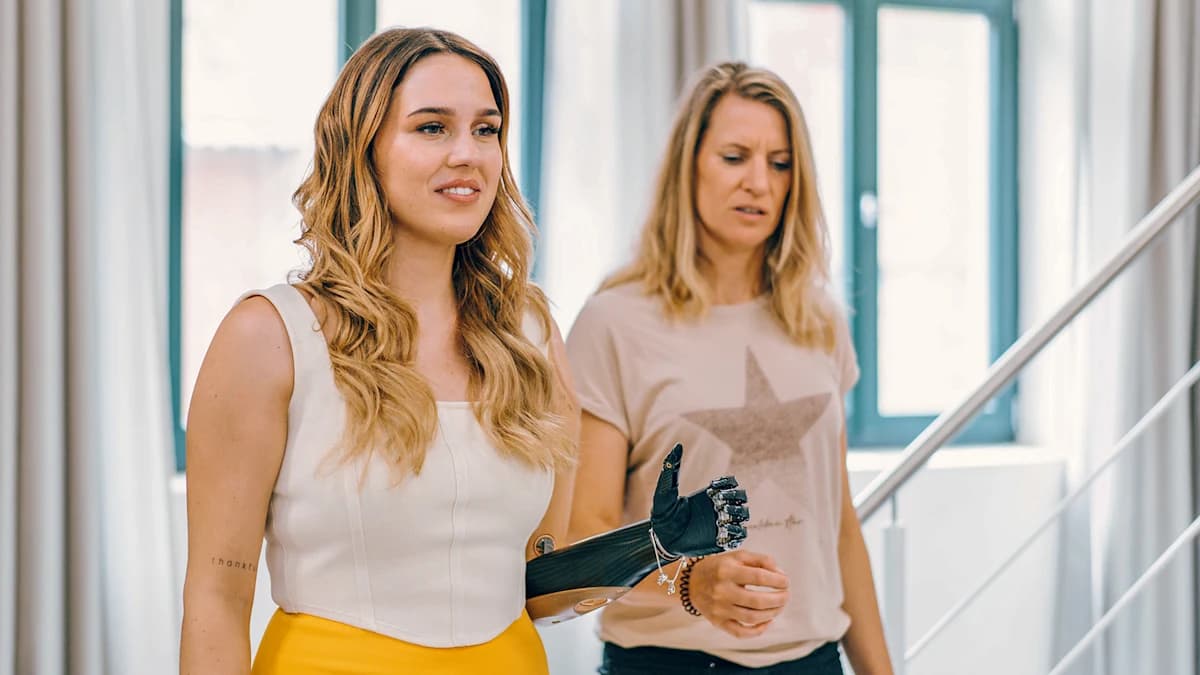
Person smiling with a custom Ottobock bebionic prosthetic hand

Life with an arm amputation

Learning to use a prosthetic arm

Talk to a specialist

Snapshot

Mastering your prosthetic arm is a process

Once your amputation surgery is complete and you begin the rehabilitation process, your care team will also help you prepare for another important step in your life after amputation: learning how to select and use a prosthesis. People with upper limb differences today have many different kinds of prosthetic arms to choose from, if they decide to use one.

While none of these devices can fully replace your hand or arm, the right one can be a valuable tool — one that helps make many activities, hobbies, and tasks much easier for you. Like any tool that's new to you, learning to use a prosthetic hand takes time, practice, and dedication.

This article covers a few important topics to focus on when you're just getting started:

  • The different kinds of prosthetic hands your prosthetist may discuss with you
  • How your prosthetist will customise your new device for your residual limb
  • Daily activities that can help you get the most from your prosthetic arm

Picking a prosthesis

Selecting the right device for you

If you decide you want to try a prosthetic arm, a prosthetist on your care team will help you explore the different options you can choose from and understand which one is best for you. Each device has different advantages, so it's important to talk to your prosthetist about which one will be the best fit for your lifestyle, hobbies, and job.

Some of the most popular kinds of prosthetic hand include:

01

Multi-grip hands

These state-of-the-art devices use electrical signals from the muscles in your residual limb ("myoelectric" signals) to move the mechanical fingers and/or thumb in a way that mimics the human hand. The bebionic hand and Michelangelo hand are good examples.

02

VariPlus hands

These myoelectric devices give the user precise, open-and-close control of their prosthetic hand. Simple, durable options like the MyoHand VariPlus Speed and Greifer VariPlus are often good "starter hands" for people who are new to prosthetic arms.

03

Body-powered prosthetics

These devices typically enable users to open and close a simple hook by using a harness and cable connected to your upper arm, shoulder and chest. These rugged, durable prostheses can be a good choice for people who perform many heavy-duty activities.

Which one is the right choice for you? That's an important discussion to have with your prosthetist. They'll help you understand the advantages and limitations of each device, and which one will be the best fit for your daily life.

Natural vs "bionic": How do you want your prosthetic arm to look?

This is an important question to ask yourself as you consider your options. Some people with an upper limb difference want their prosthesis to look as much like a "natural" arm as possible. Others love to show off their techy "bionic hand."

You get to choose what's most comfortable for you. If you want your prosthesis to look natural, most devices can be covered with a glove (like the MyoSkin Natural) that's customised to look like your hand. If you have a higher amputation level, you can also get natural-looking silicone prostheses that mimic the look of your arm.

Fitting your device

Crafting the perfect connection between you and your device

Once you've chosen a device, your prosthetist will start working on one of the most important parts of your prosthetic arm: the socket that connects the device to your residual limb. Your socket will be carefully customised just for you, using detailed measurements and models of your residual limb. This helps ensure your prosthesis will be comfortable, easy to move, and stay securely connected to your arm.

The customisation process may require a couple of visits to your limb centre. But once it's finished, your prosthesis should feel like you can easily wear it all day long.

MyoTest: Getting ready for a myoelectric prosthesis

If you're interested in using a multi-articulating prosthesis like bebionic or Michelangelo, your fitting process will also include some steps to determine the best way to connect your device to the muscles that will power and control it.

To prep your socket for one of these devices, your prosthetist will perform a MyoTest: a series of measurements that help them verify that your residual limb is compatible with a myoelectric device, and then identify the best placement for your electrodes.

If your residual limb is a good fit for a myoelectric prosthesis, your prosthetist will then use your MyoTest results to craft a socket that helps give you consistent, comfortable control of your myoelectric device.

Day-to-day use

Learning how to get the most from your prosthesis

Once your prosthesis is complete and ready to wear, your prosthetist will show you how to start using it. This training will usually focus on mastering basic movements, key grips, and everyday tasks you need to know how to manage. Once you're home, though, the real learning process starts.

Getting started with your device

When you're just starting to use a prosthetic arm, don't worry if some movements and activities are difficult for you. Remember: you're relearning how to do a lot of things with a tool instead of your hand. It will take time, but if you keep practicing you'll get more confident and capable every day.

Here are a few useful tips and tricks to help you build this important new skill.

Tip 01

Start simple and easy

As your prosthetist will tell you, mastering the basic functions of your new hand is the most important first step. Depending on your prosthetic arm, that may include opening and closing the hand, rotating the wrist, and flexing and stretching the elbow joint. Practice these simple movements with lightweight objects — a tennis ball, shoes, a remote control, or a cup — until you feel confident.

Tip 02

Use the 5-try rule

Any time you're learning a complex new skill, practicing it repeatedly can get frustrating after a while — and that feeling can make it harder to come back and try again later. When you're working on a new prosthetic arm skill, don't keep pushing until you've perfected it. Try it 5 times, and if you haven't got it, come back and try again later.

Tip 03

Train every day

Like any new skill, learning to use a prosthetic arm takes dedication and consistency. Try to use your prosthesis every day, even if it's just for a few hours at a time to start. During the fitting process, your prosthetist will also give you some exercises tailored to your amputation and device. The more you do, the quicker you'll get back to activities you love.

Building up to bigger challenges

Once you've confidently mastered basic movements and simple tasks, you'll be ready for more complex movements and activities. Take the same smart approach: practice every single day, but always give yourself breaks to rest and reset between tries.

Here are a few good activities that can help you practice combining a few simple skills:

  • Folding towels or laundry
  • Getting dressed or undressed
  • Opening bottles, jars, or other containers
  • Using a knife and fork

When you first try out these more complicated activities, keep in mind that losing a hand or arm will also affect your balance and coordination. Your prosthetic arm won't give you the same instinctive feedback about where it is, what it's doing, and where it may guide the rest of your body. Practicing hand-eye coordination with your device is an important part of learning how to use it safely and successfully.

Putting on and taking off your device

The skills you need for these steps will be different depending on:

  • The type of prosthesis you choose
  • The shape and size of your residual limb
  • Whether you've lost one or both upper limbs

Your prosthetist will give you detailed training on the best way for you to put on or take off your device. Make sure you feel comfortable and confident with these steps before you head home with your prosthesis.

If you decide to use a myoelectric device, slightly moisten the skin of your residual limb where it comes in contact with the electrodes in your socket. This will make it easier for nerve signals to travel from your muscles to the motors that power your device.

Care and cleaning

Just like your natural hand, your prosthetic arm works hard every day — so it needs the same kind of consistent daily cleaning. A few important things to remember:

  • Regularly wipe the inner socket with a damp cloth to remove any remaining perspiration and skin particles
  • If you use a prosthetic glove, regularly clean it according to the care instructions and check it for cracks. If you find any, the glove may need to be replaced
  • If you wear a liner, clean it daily according to the instructions for use

Learn more

See what's next for your journey with an upper limb difference

Person preparing for amputation surgery

Getting ready

Preparing for your amputation surgery

An amputation is a major medical procedure that your care team will carefully plan and prepare you for. Find out what to expect from that important process.

Read more
Rehabilitation after arm amputation

Recovery

Amputation rehab after losing a hand or arm

After your procedure, you and your care team will work together to help you manage your residual limb and learn how to use a prosthetic. See what the rehab process looks like.

Read more
Bionic life community

Joining the community

Exploring bionic life stories

Discover a remarkable group of people who've come together to share their experiences and tips for living an empowered life with a bionic hand. Come explore their inspiring stories.

Read more

Frequently asked questions

Every person is different, but learning to use a prosthetic arm typically takes weeks to months of consistent daily practice. Mastering basic movements like grasping and rotating the wrist usually comes first, followed by more complex everyday tasks. Patience and short, regular training sessions deliver the best results.

The most common options are multi-grip myoelectric hands (such as the bebionic and Michelangelo), simpler myoelectric "starter" hands like the MyoHand VariPlus Speed and Greifer VariPlus, and rugged body-powered prostheses operated with a harness and cable. Your prosthetist will help you choose based on your lifestyle, hobbies, and job.

A MyoTest is a series of measurements your prosthetist performs to verify that your residual limb can drive a myoelectric prosthesis and to identify the best electrode placement. If you're interested in a multi-articulating hand like bebionic or Michelangelo, the MyoTest is part of the fitting process.

Yes. Most devices can be covered with a customised glove (such as MyoSkin Natural) that mimics the look of your hand. For higher amputation levels, natural-looking silicone prostheses are also available. You decide whether you want a natural appearance or a visible "bionic" look.

Wipe the inner socket daily with a damp cloth to remove perspiration and skin particles. Clean any prosthetic glove according to the care instructions and check for cracks. If you wear a liner, clean it every day according to the manufacturer's directions.

Myoelectric devices read tiny electrical signals through the skin. If the skin is dry, the signal can be weaker. Lightly moisten the skin where the electrodes contact your residual limb before putting on the prosthesis to improve responsiveness.

Ready to get started with your prosthetic arm?

Our specialist team will guide you through every step — from selecting the right device to a custom socket fitting and ongoing rehabilitation support.

Contact Us
Contact